


World's No 1 Eco Friendly Cement Company
Building material for
a greener planet
Our low-carbon products are revolutionising the building
material industry in India and setting benchmarks in
sustainable construction around the world.
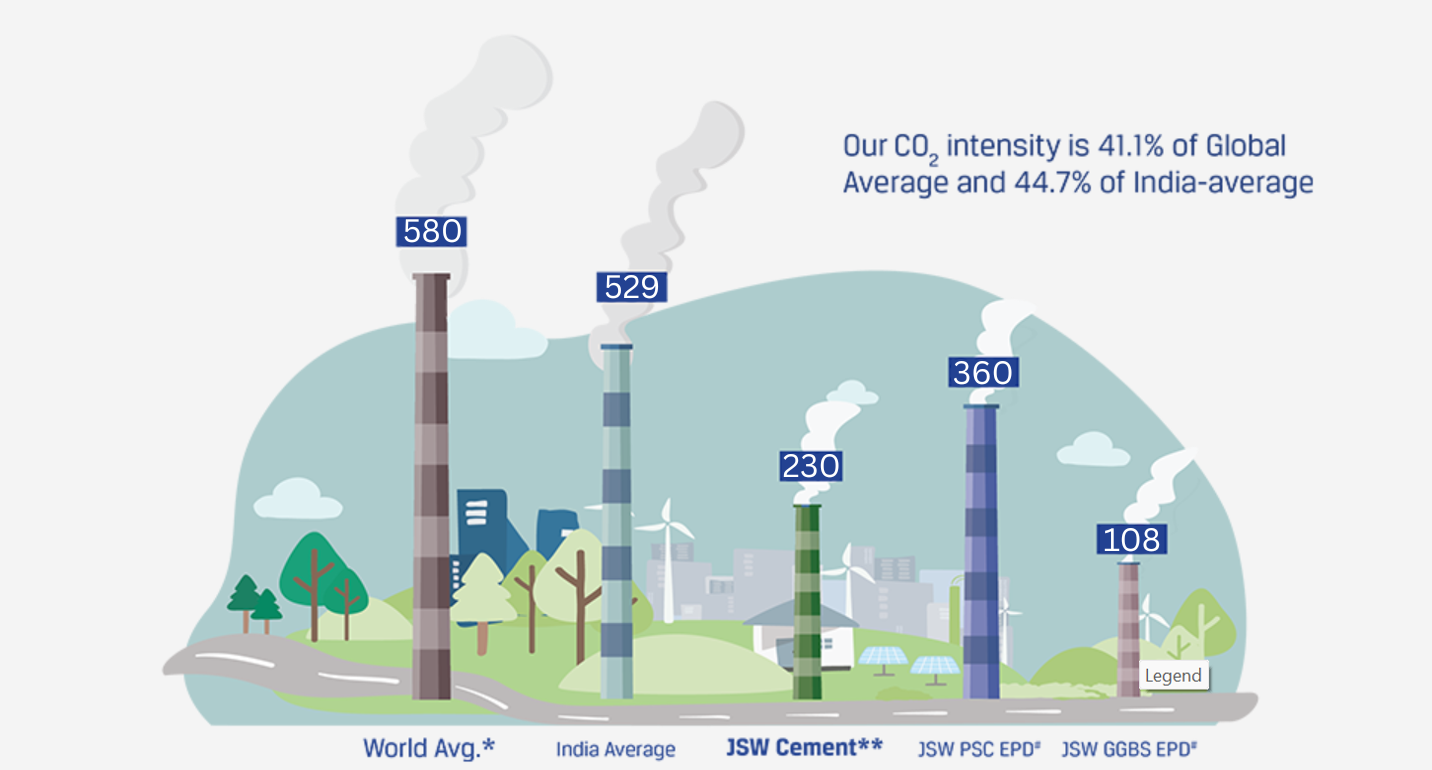
In FY25, we have emitted 52% less CO2 as compared to India’s average and 54% less CO2 as compared to the global average.
The global average CO₂ emission is 562 kg, and for India it is 535 kg, while at JSW Cement the average stands at 258 kg CO₂ per tonne of cementitious material.

Concreel HD
325 kgs of CO2 is emitted on the production of 1 tonne of Concreel HD against an Indian average of 560 Kgs.

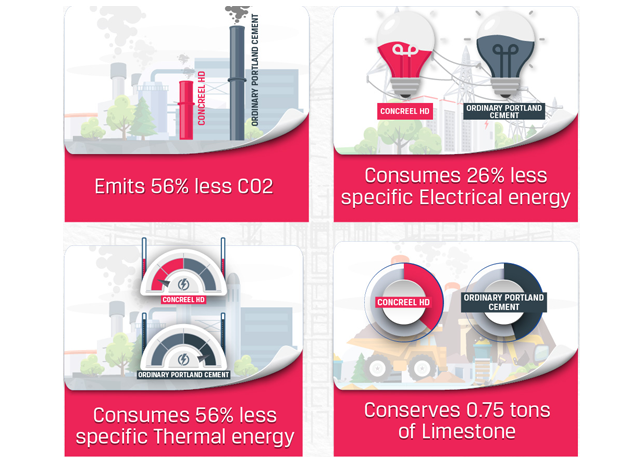
This comparison is 1 tonne of Concreel HD produced against 1 tonne of Ordinary Premium Cement
Premium Slag Cement
300 Kgs of CO2 is emitted on the production of 1 tonne of JSW <br>PSC against an Indian average of 560 Kgs
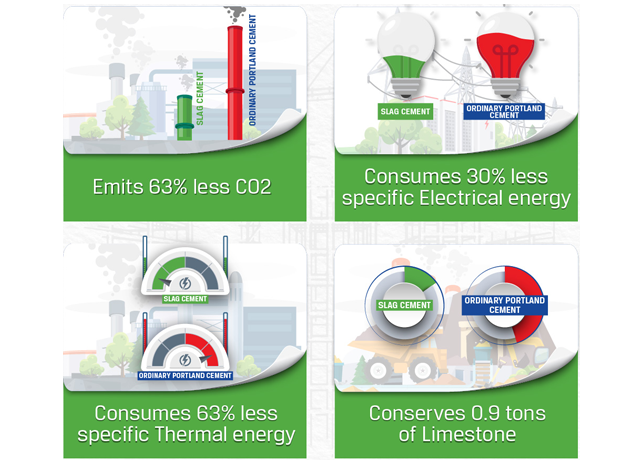
This comparison is 1 tonne of Slag Cement produced against 1 tonne of Ordinary Premium Cement
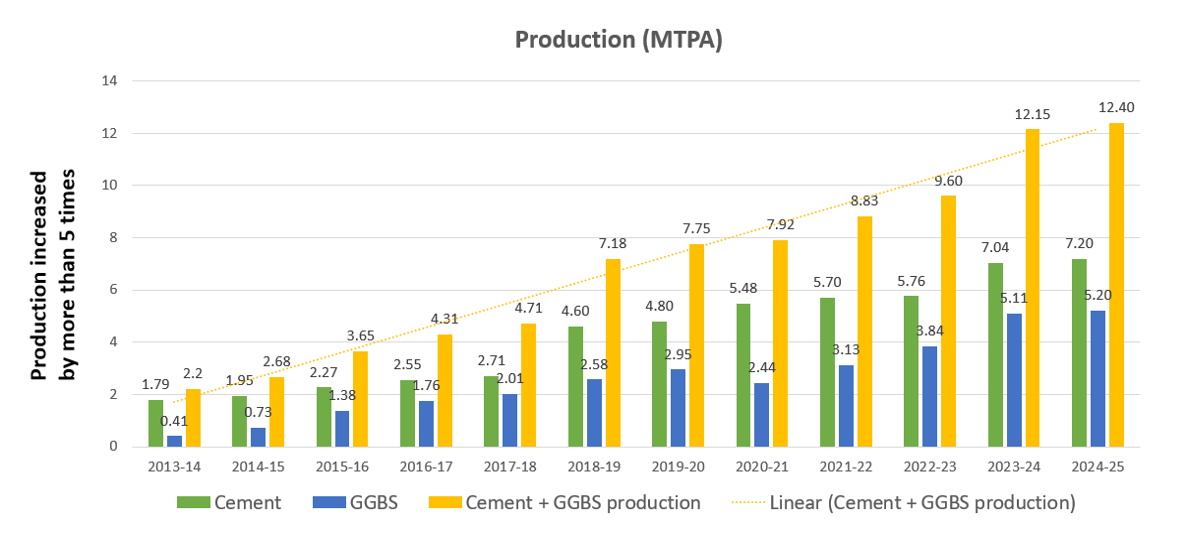
Production of cement and GGBS
From FY 2013-14 to FY 2023-24 (duration of eleven years), our production has increased from 2.2 to 12.1 MT of cement & GGBS.
Carbon footprint
In the same period, the carbon intensity has been reduced substantially from 522 kg CO2 per tonne of cementitious material to 230 kg CO2 per tonne of cementitious material for Scope-1 emissions and from 596 kg CO2 to 258 kg CO2 per tonne of cementitious material for Scope 1+2 emissions. Cumulative annual reduction rate/decarbonisation rate of carbon intensity over twelve years is 6.6%.
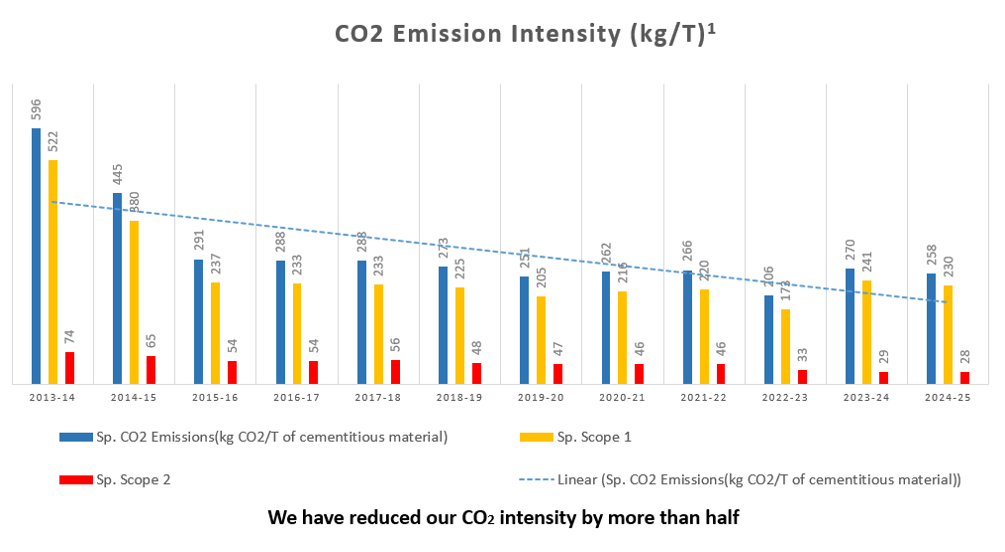

As per the GCCA GNR 2019 data, the average specific Net CO₂ emissions are 608 kg CO₂ per tonne of cementitious material for the world and 560 kg CO₂ per tonne of cementitious material for India. At JSW Cement, we are powered by sustainable initiatives and a green product mix, bringing our specific Net CO₂ emissions to 230 kg CO₂ per tonne of cementitious material during FY 2024–25, and our specific CO₂ emissions are approximately 40% of the world average and around 43% of the India average.