



RCC Concrete
Table of contents
- What is RCC? - Definition & Explanation
- Reinforcement Types Used in RCC
- Raw Materials in RCC Concrete
- Advantages & Disadvantages of RCC
- Disadvantages of RCC:
- Applications of RCC
- FAQs


RCC Concrete: An Overview
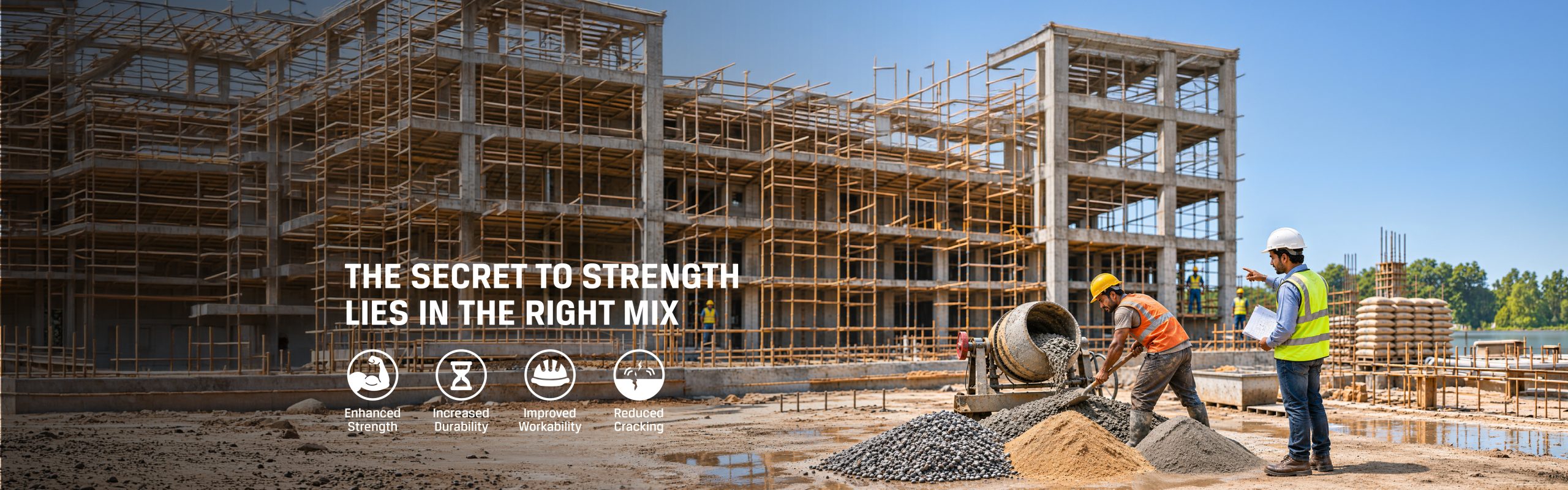
RCC Concrete, or Reinforced Cement Concrete, is a composite construction material made by combining concrete with steel reinforcement. Concrete provides high compressive strength, while steel reinforcement helps the structure resist tensile forces. This combination makes RCC suitable for constructing strong, durable and load-bearing structures.
What is RCC? - Definition & Explanation
RCC stands for Reinforced Cement Concrete. It is a composite construction material consisting of cement, fine aggregate, coarse aggregate, water and steel reinforcement. The concrete surrounds the reinforcement and protects it, while the steel helps carry tensile stresses that concrete alone cannot effectively resist.
RCC can be moulded into different shapes and structural members such as slabs, beams, columns and foundations. Its strength and durability depend on factors such as concrete grade, Types of cements, SCMs and Admixtures used, reinforcement detailing, material quality, workmanship, curing and exposure conditions.
Reinforcement Types Used in RCC
Steel reinforcement is provided in RCC to improve its tensile and structural performance. Common reinforcement forms include:
- Mild Steel Bars: These can be used in applications where relatively high ductility is required.
- High-Strength Deformed Bars (HYSD/TMT Bars): These are commonly used in RCC structures because their surface ribs provide better bonding with concrete.
- Welded Wire Mesh: This consists of prefabricated steel wires arranged in a grid and is used where distributed reinforcement is required like slab on grade applications.
- Prestressed Concrete: These are used in bridges and large structures where high tensile strength is required.
The type, diameter, spacing and arrangement of reinforcement should be decided according to structural design requirements.
Raw Materials in RCC Concrete
The primary materials used in RCC Concrete include:
- Cement: Acts as the binding material in concrete.
- SCMs: Mineral admixtures like Flyash, GGBS, Ultrafine GGBS, Microsilica , Ultrafine Flyash ,Rice husk Ash. etc
- Fine Aggregate: Usually River sand, Manufactured Sands (M Sand) which fills smaller voids between aggregate particles.
- Coarse Aggregate: Provides bulk and contributes to the strength and stability of concrete.
- Water: Required for hydration of cement and achieving workable concrete.
- Steel Reinforcement: Provides tensile strength and helps resist structural stresses.
- Admixtures: May be added when specific properties such as workability, setting time or durability need to be improved.
Advantages & Disadvantages of RCC
Advantages of RCC: RCC offers following advantages:
- High Durability: Resistant to fire, water and extreme weather conditions.
- Strength: It handles both tension and compression, thus providing robustness.
- Flexibility: It can be moulded into various shapes and is suitable for a wide range of structural applications.
- Low Maintenance: Properly designed RCC structures require relatively low maintenance during their service life.
Disadvantages of RCC:
- Skilled Labour Requirement: RCC construction requires careful control of mixing, placement, compaction and curing by skilled labour.
- Formwork Costs: Casting RCC requires temporary structures like centering, shuttering and moulds (Form work) which significantly increase material and labour costs.
- Relatively Heavy Weight: RCC structures are much heavier than steel, wood, or glass structures, which demands stronger and deeper foundations.
- Shrinkage and Cracking: If design, detailing or construction practices are inadequate, volume shrinkage during drying and hardening may lead to cracking.
Applications of RCC
RCC is widely used in residential, commercial, industrial and infrastructure projects, including:
- Foundations and footings.
- Beams and columns.
- Roof and floor slabs.
- Bridges and flyovers.
- Roads and pavements.
- Dams and water-retaining structures.
- Industrial and commercial buildings.
- Infrastructure projects
FAQs
What is RCC Concrete?
RCC Concrete is Reinforced Cement Concrete, made by combining concrete with steel reinforcement to provide strength against both compressive and tensile forces.
Why is M20 used for RCC?
M20 concrete has a characteristic compressive strength of 20 MPa at 28 days and is commonly used for several residential RCC applications. However, the appropriate concrete grade should be selected according to structural design, loads, exposure conditions and project specifications.
What are five types of concrete?
Five commonly encountered forms or categories are plain cement concrete(PCC), Reinforce Cement Concrete (RCC), pre stressed concrete, precast concrete and ready-mix concrete. These categories can overlap because they describe different aspects of concrete construction.
Which grade of cement is best for RCC?
There is no single cement grade that is best for every RCC application. Cement selection should follow the concrete mix design and project requirements. Commonly used cement grades include M20, M25 and M30.
What is RCC Structure work?
RCC structure work involves constructing reinforced concrete structural members such as foundations, columns, beams and slabs. It generally includes reinforcement fixing, formwork, concrete placement, compaction and curing.








Our Subsidiary -
 cement
JSW Cement. Copyright 2026 - All rights reserved.